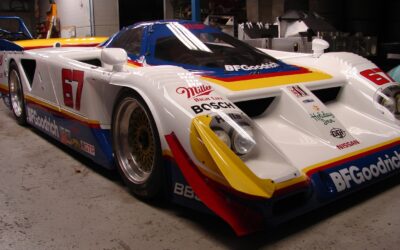
Intrepid RM-1



Specification
Race Category: IMSA Camel GTP Championship
Livery:
Year: 1991
Designer: Bob Riley and Bill Riley
Chassis Number:
Chassis Construction: Carbon-fibre composite monocoque with steel roll cage structure
Weight: 817–850 kg
Aerodynamics:
Body Style: Closed-cockpit endurance prototype
Steering Position:
Suspension: Double wishbone suspension with pushrod-operated dampers
Brakes: Ventilated racing disc brakes
Engine Details: Katech-built Chevrolet V8
Engine Layout: Mid-mounted longitudinal
Engine Size: 6.5-litre (396 cu in) naturally aspirated V8
Engine Power: 800 bhp
Fuel Type: Petrol
Drive Configuration: RWD
Transmission: Hewland 5-speed manual racing gearbox
Detailed Overview
£
Description
The BMW GTP, based on the March 86G chassis, was one of the most extreme and technically fascinating prototypes of the IMSA GTP era. Created for BMW North America’s assault on the 1986 IMSA Camel GTP Championship, the car combined a lightweight March-designed chassis with a highly modified version of BMW’s legendary Formula One turbo engine. The result was a prototype capable of producing staggering power figures that remain impressive even by modern standards.
Designed by Gordon Coppuck, the March 86G featured a narrow aluminium monocoque reinforced with carbon-fibre honeycomb structures, making it both lighter and stiffer than previous March GTP designs. The chassis was among the first race cars developed extensively using CAD technology, representing a significant step forward in race car engineering.
Its most remarkable feature was the BMW M12/14 turbocharged 2.0-litre four-cylinder engine. Derived directly from the Formula One powerplant that powered Nelson Piquet to the 1983 World Championship, the endurance version produced around 800 horsepower in race trim. In qualifying specification, output was reputed to exceed 1,400 horsepower, making it one of the most powerful racing engines ever used in circuit competition.
Despite its breathtaking performance, the BMW GTP struggled with reliability throughout its short career. Engine failures, gearbox problems, and recurring fires limited results, although the car demonstrated flashes of genuine brilliance, most notably with its victory at Watkins Glen. After a single season, BMW ended the programme, leaving the BMW GTP as one of endurance racing’s great “what if” stories.
Today, the BMW GTP is remembered as a spectacularly powerful IMSA prototype that showcased the extraordinary potential of BMW’s turbocharged engineering during the golden age of sports car racing.
Race History
- Commissioned By: Jim Miller Racing after competing with Spice GTP prototypes.
- Built By: Pratt & Miller, with design led by Bob and Bill Riley.
- Competition Debut: 1991 IMSA Camel GTP Championship.
- Design Philosophy: Prioritised maximum downforce and cornering speed over outright top speed, unlike most contemporary GTP cars.
- Performance Strengths: Exceptional grip and cornering ability on technical road circuits.
- First Victory: Won the 1991 Grand Prix of New Orleans driven by Tommy Kendall.
- Primary Rivals: Nissan NPT-90, Toyota Eagle MkIII, Jaguar XJR prototypes, and Porsche 962s.
- Challenges: High drag reduced straight-line speed and the car suffered reliability and durability issues.
- Notable Incident: Tommy Kendall suffered a major crash at Watkins Glen in 1992 following a suspension failure.
- Legacy: Widely regarded as one of the most innovative IMSA GTP cars ever built and an important stepping stone in the rise of Pratt & Miller as a world-class motorsport engineering company.
Features
- Focus: Maximum cornering performance through aerodynamic downforce
- Notable Traits: Distinctive shovel-nose bodywork, revolutionary downforce philosophy, Pratt & Miller’s first major prototype project