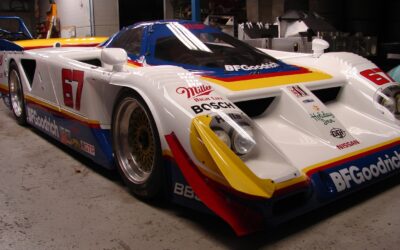
Jaguar XJR9LM
This car, chassis #186 has a huge history of racing with the Silk Cut Jaguar team. The car made it's debut at the Monza 300km as an XJR6 back in 1986 in the hands of Gianfranco Brancatelli and Jean-Louis Schlesser. The car went on to compete in five more events in the season with a number of different drivers. In 1987 the car, now an XJR8, competed at Silverstone and Le Mans driven by Martin Brundle and John Neilson. The car's final outing, now an XJR9 LM, was the 1988 Le Mans 24 Hour race where it finished an impressive 4th place piloted by Derek Daly, Larry Perkins and Kevin Cogan. The car now carries the the livery from this race.


Specification
Race Category: Group C Sports Prototype
Livery: Silk Cut
Year: 1988
Designer: Tony Southgate
Chassis Number: 186
Chassis Construction: Carbon-fibre and aluminium honeycomb monocoque
Weight:
Aerodynamics: Low-drag long-tail Le Mans bodywork package
Body Style: Closed-cockpit endurance prototype
Steering Position: Center
Suspension: Double wishbone suspension with pushrod-operated dampers
Brakes:
Engine Details: Jaguar
Engine Layout: Mid-mounted longitudinal
Engine Size: 7.0l V12
Engine Power: 720bhp
Fuel Type: Petrol
Drive Configuration: RWD
Transmission: TWR 5-speed manual racing gearbox
Detailed Overview
£NA
Description
The Jaguar XJR-9LM is one of the most iconic endurance racing cars of the Group C era, representing the peak of Jaguar’s factory-backed assault on international sports car racing during the late 1980s. Developed by Tom Walkinshaw Racing for Jaguar Cars, the XJR-9LM was a specialised Le Mans evolution of the successful XJR-9 prototype, engineered specifically for the unique demands of the 24 Hours of Le Mans. Combining advanced aerodynamics, immense V12 power, and exceptional endurance reliability, the car became a defining symbol of Jaguar’s return to top-level prototype racing glory.
At the heart of the XJR-9LM was Jaguar’s legendary naturally aspirated 7.0-litre V12 engine, producing around 720 horsepower with a distinctive exhaust note that became synonymous with Group C racing. Unlike many rivals that relied on turbocharged powerplants, Jaguar’s V12 delivered smooth and consistent power over long distances while also proving remarkably durable in endurance conditions. The engine was mounted within a lightweight aluminium honeycomb and carbon-composite monocoque chassis, giving the car an excellent balance of strength, rigidity, and weight efficiency.
The “LM” designation identified the long-tail, low-drag aerodynamic package developed specifically for Le Mans. Engineers refined the bodywork to maximise straight-line speed on the Mulsanne Straight while maintaining stability through the circuit’s high-speed corners. The result was a prototype capable of exceeding 240 mph while remaining composed during extended race stints. The car’s suspension system utilised double wishbones with pushrod-operated dampers, providing precise handling and adaptability for endurance racing setups.
The Jaguar XJR-9LM achieved motorsport immortality at the 1988 24 Hours of Le Mans, where the Silk Cut-liveried machine driven by Jan Lammers, Johnny Dumfries, and Andy Wallace secured overall victory. The win was historically significant, ending Porsche’s long-standing dominance at Le Mans and giving Jaguar its first outright victory at the race since 1957. The triumph cemented the XJR-9LM as one of the greatest endurance racing cars ever produced and established Jaguar as a major force in Group C competition.
Today, the Jaguar XJR-9LM remains one of the most celebrated and recognisable sports prototypes in motorsport history. Revered for its elegant design, thunderous V12 soundtrack, and historic Le Mans success, the car continues to appear at prestigious historic racing events and demonstrations, where it stands as a lasting symbol of the golden age of endurance racing.
Race History
- Developed By: Tom Walkinshaw Racing for factory-backed Jaguar Cars endurance racing programme
- Purpose: Special long-tail “LM” specification created specifically for the 24 Hours of Le Mans
- Competition Debut: 1988 World Sportscar Championship season
- Le Mans Victory: Won the 1988 24 Hours of Le Mans with drivers Jan Lammers, Johnny Dumfries, and Andy Wallace
- Historic Importance: Ended Porsche’s dominant Le Mans winning streak
- Primary Rivals: Porsche 962C, Sauber-Mercedes C9, Nissan Group C prototypes
- Performance Strengths: Exceptional high-speed stability, V12 reliability, and low-drag efficiency
- Championship Success: Competitive throughout the 1988 endurance racing season
- Notable Drivers: Jan Lammers, Andy Wallace, Johnny Dumfries, Martin Brundle, Derek Warwick
- Legacy: One of the most iconic and celebrated Group C endurance race cars ever built
- Historic Motorsport Presence: Frequently featured at historic Le Mans and Group C demonstration events
Features
Comments
Maximum straight-line speed and endurance reliability for Le Mans. Iconic Silk Cut livery, thunderous V12 engine, Le Mans-winning design.