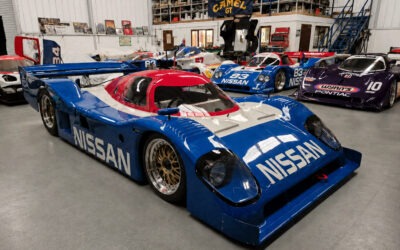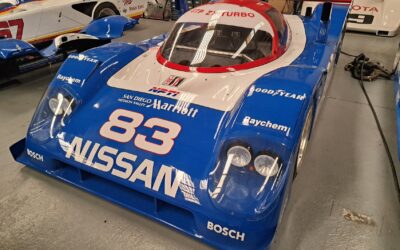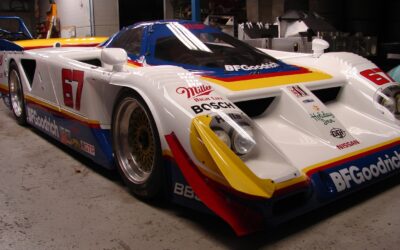
Ford Zakspeed Probe
The Ford Zakspeed Probe was a late-1980s Group C and IMSA GTP endurance racing prototype developed by Ford Motor Company and Zakspeed. Featuring advanced ground-effect aerodynamics, a lightweight composite chassis, and a turbocharged engine derived from Zakspeed’s Formula One programme, the Probe was built for high-speed endurance competition. Its futuristic design and powerful performance made it one of the most distinctive sports prototypes of its era.


Specification
Race Category: Group C / IMSA GTP sports prototype
Livery: Dunlop
Year: 1985
Designer: Tony Southgate
Chassis Number:
Chassis Construction: Carbon-fibre and aluminium composite monocoque
Weight:
Aerodynamics: Full ground-effect underbody with enclosed rear bodywork
Body Style: Closed-cockpit endurance prototype
Steering Position:
Suspension: Double wishbone suspension with coil springs and dampers
Brakes:
Engine Details: ZAKSPEED
Engine Layout: Mid-mounted longitudinal
Engine Size: 2.1LTR TURBO
Engine Power: 600-650bhp
Fuel Type: Petrol
Drive Configuration: RWD
Transmission: 5-speed manual racing gearbox
Detailed Overview
£POA
Description
The Ford Zakspeed Probe was a highly advanced Group C and IMSA GTP sports prototype race car developed during the late 1980s through a collaboration between Ford Motor Company and Zakspeed. Designed primarily for endurance racing competition in Europe and North America, the car combined aggressive aerodynamics, lightweight construction, and turbocharged power derived from Zakspeed’s Formula One engineering programme.
The Probe featured a low-slung carbon-fibre and aluminium composite chassis with full ground-effect aerodynamics, allowing it to generate substantial downforce while maintaining exceptional straight-line speed. Its distinctive bodywork included enclosed rear wheels, deep side tunnels, and an aerodynamic cockpit canopy optimised for high-speed endurance racing circuits such as Le Mans and Daytona.
Power came from a turbocharged four-cylinder engine developed by Zakspeed, based on the company’s successful Formula One turbo technology. Depending on race specification and boost levels, the engine produced in excess of 600 bhp, delivering impressive acceleration and top-end performance. A rear-wheel-drive layout and advanced suspension system provided sharp handling and stability during long-distance competition.
Although the Ford Zakspeed Probe showed strong potential and impressive pace, reliability challenges and fierce factory competition limited its overall race success. Despite this, the car remains an iconic example of late-1980s prototype racing technology and is remembered for its futuristic styling, engineering ambition, and connection to Ford’s international motorsport programmes.
Race History
- Developed For: FIA Group C and IMSA GTP endurance racing categories
- Debut Season: 1989 World Sportscar Championship
- Team: Factory-backed Zakspeed programme with support from Ford Motor Company
- 1989 Le Mans Entry: Entered for the 24 Hours of Le Mans but struggled with reliability issues
- Performance Strengths: Strong straight-line speed and advanced aerodynamic efficiency
- Challenges: Turbo reliability, cooling difficulties, and limited development budget compared to major factory teams
- Notable Drivers: Klaus Niedzwiedz, Frank Jelinski, and other experienced endurance racers
- Competition History: Appeared in selected World Sportscar Championship endurance events during the late 1980s and early 1990s
- Legacy: Remembered as one of the most visually distinctive and technically ambitious Ford-backed Group C prototypes
- Historic Motorsport: Surviving examples occasionally appear at historic Group C demonstrations and motorsport festivals today
Features
Comments
High-speed endurance racing and aerodynamic efficiency. Formula One-derived turbo technology, futuristic styling, advanced aerodynamics.