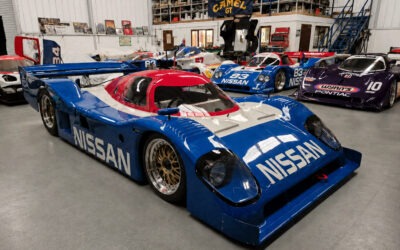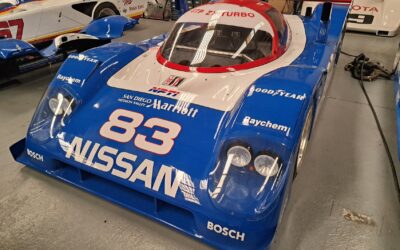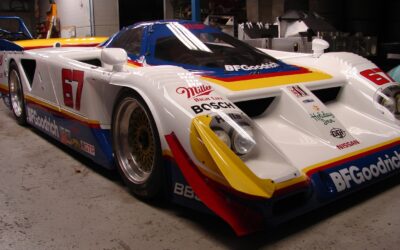
Nissan Lola T710
One of two Nissans built by Electramotive using Lola chassis.


Specification
Race Category: Group C Sports Prototype
Livery: Nissan
Year: 1986
Designer:
Chassis Number:
Chassis Construction: Lola chassis
Weight:
Aerodynamics:
Body Style: Enclosed Prototype
Steering Position: Center
Suspension: Double wishbone suspension with pushrod-operated dampers
Brakes:
Engine Details: Nissan
Engine Layout: Mid-mounted longitudinal
Engine Size: 3.0 litre V6
Engine Power: 600 bhp
Fuel Type:
Drive Configuration: RWD
Transmission: 6-speed manual racing gearbox
Detailed Overview
£POA
Description
The Nissan Lola T710 was an endurance racing prototype developed during the final years of the Group C era, combining the chassis expertise of Lola Cars with naturally aspirated engine technology from Nissan. Created for the early-1990s 3.5-litre sports prototype regulations, the car reflected the dramatic shift in endurance racing toward Formula One-inspired engineering, lightweight construction, and high-revving naturally aspirated engines.
Built around a carbon-fibre composite monocoque chassis, the T710 featured an open-cockpit design with sleek aerodynamic bodywork engineered to maximise downforce and cornering performance. The car’s lightweight structure and compact dimensions gave it excellent agility and responsiveness, while advanced airflow management improved stability at high speeds. Pushrod-operated suspension and double wishbone geometry provided precise handling characteristics and allowed teams to adapt setups for a variety of endurance circuits.
Power came from a 3.5-litre naturally aspirated Nissan V8 engine producing approximately 600 horsepower. Designed to meet the FIA’s new prototype regulations, the engine delivered sharp throttle response and strong top-end performance similar to contemporary Formula One technology. Paired with a six-speed manual racing gearbox, the drivetrain provided competitive acceleration and efficient power delivery during endurance competition.
The Nissan Lola T710 competed during one of the most technically advanced yet financially challenging periods in sports car racing history. Facing factory-backed rivals such as the Peugeot 905 and Toyota TS010, the car struggled to achieve major success against larger development programmes. Nevertheless, it earned respect for its balanced engineering, lightweight performance, and role in the final evolution of Group C racing.
Today, the Nissan Lola T710 remains an interesting and relatively rare prototype from endurance racing’s transitional era. Its combination of Lola chassis engineering and Nissan performance technology makes it a notable example of the ambitious partnerships that defined the closing years of Group C competition.
Race History
1985:
28/7: Portland: Devendorf/Adamowicz, #83; 16th NR.
04/8: Sears Point: Devendorf/Adamowicz, #83; 9th.
25/8: Road America: Devendorf, #83; DNF.
08/9: Pocono: Devendorf, #83; 40th NR. Acc.
1986:
Re-numbered by Electramotive as 8610.2.
02/3: Miami GP: Forbes-Robinson/Adamowicz, #83; 10th.
04/5: Laguna Seca: Forbes-Robinson, #83; 19th NR.
08/6: Mid-Ohio: Forbes-Robinson/Heimrath Jr, #83; 7th.
27/7: Portland: Brabham/Watson, #83; 3rd.(Pole position).
03/8: Sears Point: Forbes-Robinson, #83; 4th.
24/8: Road America: Forbes-Robinson/Brabham, #83; 47th NR.
20/9: Watkins Glen: Forbes-Robinson/Lammers, #83; 24th NR.
5/10: Columbus: Forbes-Robinson/Brabham, #83; 5th. (Pole position).
1987:
26/4: Riverside: E. Forbes-Robinson, #83; DNF. (Pole position).
03/05: Laguna Seca: D. Hobbs, #83; 5th.
07/06: Mid-Ohio: G. Brabham/E. Forbes-Robinson, ; 17thNR. Pole. (Cracked cross-member.)
05/07: Watkins Glen: H. Haywood/E. Forbes-Robinson, #83; DNF. (Tire.)
26/07: Portland: G. Brabham/E. Forbes-Robinson, #83; 19thNR. Pole.(Overheating.)
02/08: Sears Point: J. Morton/E. Forbes-Robinson, #83; 17th. (Oil pressure.)
16/08: Road America: J. Morton/E. Forbes-Robinson, #83; 16th. Pole. (Coil.)
06/09: San Antonio: E. Forbes-Robinson, #83; DNF. (Accident.)
Car stored then tub repaired with carbon floor.
Show car.
Sold to Louis Buffalo, Matrix Motors from Nissan.
2007: Under restoration.
Features
- Developed For: FIA Sportscar World Championship under new 3.5-litre regulations
- Partnership: Collaboration between Lola Cars chassis engineering and Nissan engine technology
- Competition Era: Early 1990s Group C racing
- Primary Rivals: Peugeot 905, Toyota TS010, Mazda MXR-01, and Mercedes-Benz prototypes
- Performance Strengths: Strong chassis balance and naturally aspirated engine response
- Challenges: Limited development compared with factory-backed competitors
- Championship Participation: Competed in selected endurance racing events and prototype championships
- Legacy: Represents the final generation of naturally aspirated Group C prototypes before the category’s decline
- Historic Motorsport: Occasionally seen in historic Group C events and demonstrations today
Comments
Lightweight performance and Formula One-style naturally aspirated power. Lola customer chassis combined with Nissan racing engine development.