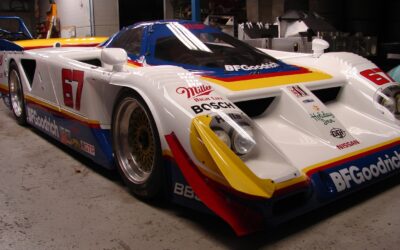
Toyota IMSA Eagle HF-89
This MkII Toyota Gurney-Eagle was driven by Fangio, Drake Olsen, Rocky Moran and PJ Jones for three consequetive season in the IMSA championship ’89-’91. At one race when Drake Olsen had put the car in pole position, the crew nicknamed the car “WILD THING” and this was written on the inside of the windscreen together with various comments by the crew. This still remains on the car today. The car was shipped over from the US last year and is undergoing a restoration and race preparation. The car’s inline 4 cylinder 2140cc DOHC 3SGTM motor is being rebuilt, along with the CT44 turbo charger.


Specification
Race Category: IMSA GTP sports prototype
Livery: Toyota
Year: 1989
Designer: Ron Hopkins (chassis) and Hiro Fujimori (aerodynamics)
Chassis Number:
Chassis Construction: Aluminium honeycomb monocoque with carbon-composite body panels
Weight: 850kg
Aerodynamics: ull ground-effect IMSA GTP bodywork with extensive venturi tunnels
Body Style: Closed-cockpit IMSA GTP prototype
Steering Position:
Suspension: Independent double wishbone suspension front and rear with coil-over dampers
Brakes: AP Racing ventilated disc brakes
Engine Details: Toyota Inline 4 cylinder 3SGTM
Engine Layout: Mid-engine
Engine Size: 2140cc DOHC
Engine Power: 600–700 bhp
Fuel Type:
Drive Configuration: RWD
Transmission: Hewland 5-speed manual transaxle
Detailed Overview
£
Description
The Toyota Eagle HF-89 marked the beginning of Toyota’s serious challenge for overall honours in the IMSA Camel GTP Championship. Designed and built by All American Racers under the direction of Dan Gurney, the HF-89 was the team’s first purpose-built IMSA GTP prototype and represented a significant leap from the successful Toyota Celica GTO programme. Combining advanced ground-effect aerodynamics with a lightweight aluminium honeycomb monocoque and a highly developed turbocharged Toyota engine, the HF-89 established the technical direction that would eventually lead to one of the most dominant prototype race cars in IMSA history.
The chassis was designed by Ron Hopkins while aerodynamic development was led by Hiro Fujimori, whose initials gave the car its “HF” designation. Advanced venturi tunnels beneath the car generated substantial ground-effect downforce, while carefully shaped carbon-composite bodywork reduced drag and improved high-speed stability. Although highly innovative, the car proved extremely sensitive to suspension settings, making it difficult to extract consistent performance across different circuits.
Power came from Toyota’s 2.1-litre turbocharged inline-four engine, developed by Toyota Racing Development (TRD). Producing around 600–700 horsepower in race trim, the compact powerplant delivered excellent reliability and strong fuel efficiency while remaining highly competitive against larger-capacity engines from Porsche and Nissan. Power was transmitted through a Hewland five-speed transaxle to the rear wheels, while independent double wishbone suspension provided the handling precision required for IMSA’s demanding circuits.
Although the HF-89 never dominated the championship, continuous development transformed it into a race-winning package. During the 1990 season, Juan Manuel Fangio II secured Toyota’s first IMSA GTP victory at Topeka before adding wins at Sears Point, San Antonio and Del Mar. A final victory at Watkins Glen in 1991 demonstrated the car’s maturity before it was superseded by the Eagle Mk III.
Race History
Today, the Toyota Eagle HF-89 is recognised as one of the most significant IMSA GTP prototypes of its era. While overshadowed by its championship-winning successor, it laid the engineering and aerodynamic foundations for the Eagle Mk III and played a pivotal role in establishing Toyota as a major force in North American prototype racing.
- Developed By: All American Racers under the leadership of Dan Gurney for Toyota’s IMSA GTP programme.
- Competition Debut: 1989 IMSA Camel GTP Championship.
- Factory Drivers: Juan Manuel Fangio II, Rocky Moran, Willy T. Ribbs and Chris Cord.
- First Victory: Topeka IMSA GTP race in 1990, giving Toyota its first-ever IMSA GTP victory.
- Further Victories: Sears Point, San Antonio, Del Mar (1990) and Watkins Glen (1991).
- Primary Rivals: Nissan GTP ZX-Turbo, Porsche 962, Jaguar XJR prototypes and Spice GTP entries.
- Engineering Challenge: The chassis was extremely quick when correctly set up but was notoriously difficult to balance, with a very narrow operating window.
- Successor: Replaced during 1991 by the revolutionary Toyota Eagle Mk III, which became one of the most successful IMSA prototypes ever built.
- Historic Legacy: An important milestone in Toyota’s North American endurance racing programme and the foundation for the championship-winning Eagle Mk III.
Features
First in-house GTP prototype developed by All American Racers for Toyota and predecessor to the dominant Eagle Mk III.